Home / Switchboards & MCCs / Switchboard modification guide
Guide · Switchboard modification
Modifying an existing switchboard under AS/NZS 61439
What changes when you add to, extend or alter a switchboard or MCC, who takes on the manufacturer's responsibilities, and what has to be verified and recorded.
Most switchboard work on an operating plant is not a new board. It is adding a circuit, swapping a breaker, fitting a VSD into a spare cubicle or bolting a new section onto an old MCC. Modifying an existing switchboard under AS/NZS 61439 is where compliance most often slips, because the person doing the work can take on the manufacturer's responsibilities without realising it. This guide explains who is responsible, what has to be verified, and when a board is better replaced.
For the general rules on new boards, verification methods and what to ask a switchboard builder, see our AS/NZS 61439 switchboard compliance guide. This page is about changes to boards already in service.
Original manufacturer and assembly manufacturer
AS/NZS 61439.1 splits responsibility between two roles. The original manufacturer is the organisation that carried out the original design and the associated verification of the assembly, usually the maker of the switchboard system. The assembly manufacturer is the organisation responsible for the completed assembly. They can be the same company or different ones.
The important rule for modifications is this: if an assembly manufacturer incorporates its own arrangements that are not covered by the original manufacturer's verification, it is deemed to be the original manufacturer for those arrangements. So an electrical contractor who adds a busbar extension of their own design, fits a device the original system was never verified with, or changes the cooling, takes on the design verification duty for that part of the board.
- Working within the original system: using the original manufacturer's components and following their documented instructions and ratings, you act as the assembly manufacturer and do routine verification
- Going outside it: using other components or arrangements, you become the original manufacturer for those parts and must design-verify them, by test, comparison or assessment
- Either way: whoever modifies the board is responsible for the completed result, including updating the records and labels
Design verification and routine verification
The standard separates two kinds of checking. Design verification (Section 10 of AS/NZS 61439.1) proves that a design meets the standard. It covers characteristics such as strength of materials, degree of protection, clearances and creepage, protective circuits, incorporation of switching devices, internal circuits, terminals, dielectric properties, temperature rise, short-circuit withstand, EMC and mechanical operation. It can be done by test, by comparison with a tested reference design, or by assessment, within the limits the standard sets for each.
Routine verification (Section 11) is done on every assembly to find faults in materials and workmanship: degree of protection, clearances, protection against electric shock and protective circuit integrity, built-in components, internal connections and tightness, terminals, mechanical operation, dielectric tests and wiring and functional checks.
For a modification, routine verification applies to the parts you have changed and anything they affect. Design verification applies to any new arrangement not already covered by the original verification. The trap is assuming a quick insulation resistance test after the work is the same as verification. It is not.
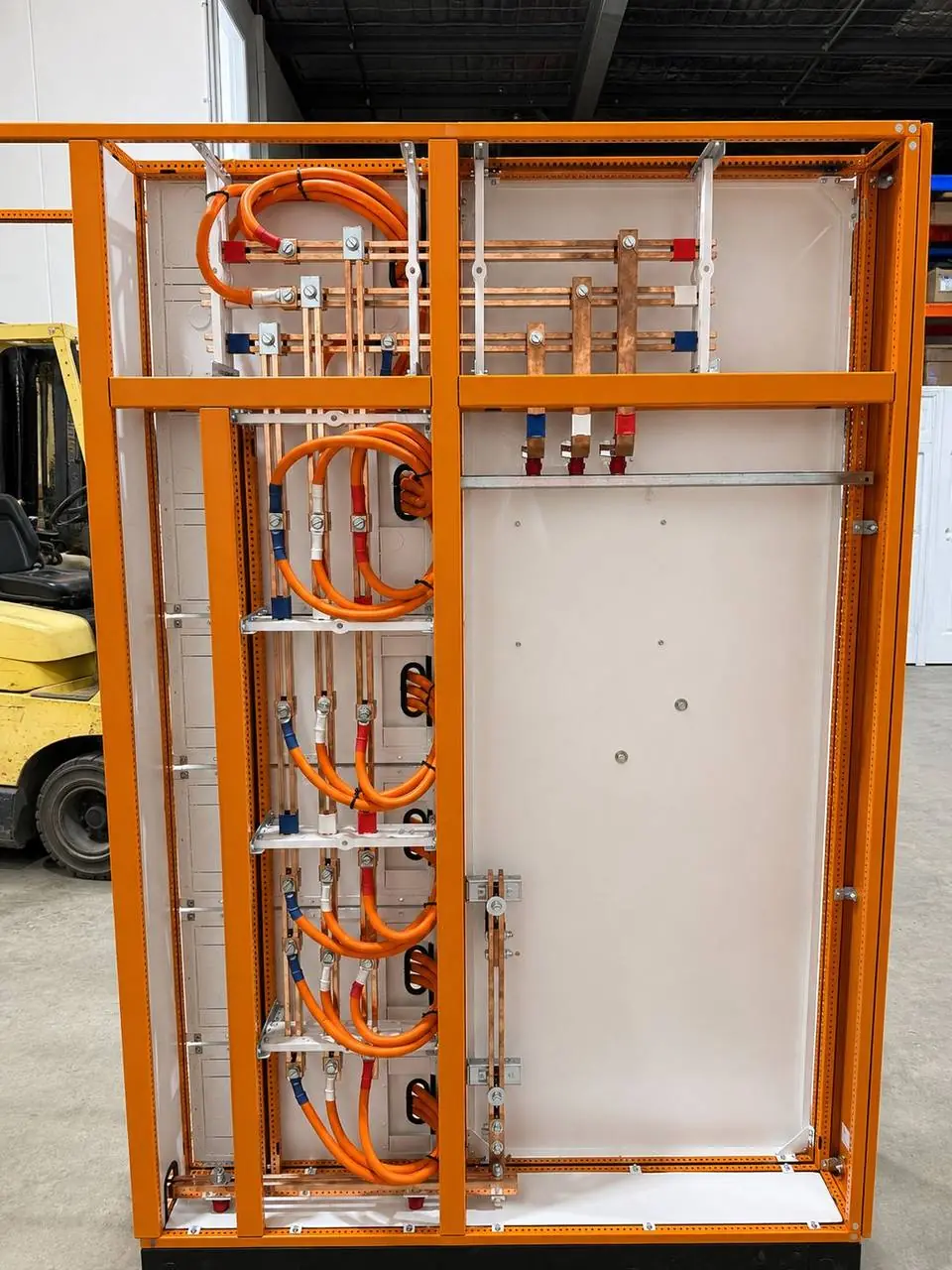
What you can and can't change
| Change | Usually fine as a modification if | Needs more work or a new design when |
|---|---|---|
| Adding a circuit in a spare way | The spare way, device and ratings are from the original system and within its documented limits | The board has no records, or the new load pushes the busbar or incomer past its rating |
| Changing a protective device | Same make and range, same or lower rating, the same short-circuit coordination data | A different make or frame, a higher rating or a different cut-off current |
| Adding a VSD or soft starter | There is verified space, cooling and segregation for it | The heat it adds takes the compartment over its temperature-rise limit |
| Adding a new section or cubicle | It is the same system, joined the way the original manufacturer documents | It is a different system, or the busbar joint is not a verified arrangement |
| Supply or fault level change | Prospective fault current stays within the board's rated short-circuit values | A bigger transformer or new supply raises the fault level above the rating |
The questions behind every row are the same.
- Fault level: is the board's rated short-time or conditional short-circuit current still above the prospective fault current, and are new devices coordinated with the upstream protection the way the original verification assumed?
- Temperature rise: does the new load or device keep each compartment, busbar and device within its limits? Adding a drive, filling a spare way or raising a diversity assumption can tip a board over
- Busbar and incomer ratings: the total load must not exceed the smaller of the busbar or incomer rating. Upsizing an incomer without re-verifying the busbars is a common mistake
- Form of separation: a Form 3b or 4 board loses its separation if barriers or shrouds are left off, or if cables are run through other compartments
- Degree of protection: new cable entries, cut-outs and fans must keep the board's IP rating
- Arc fault: AS/NZS 3000 requires the harmful effects of an internal arcing fault to be limited on larger switchboards, and AS/NZS 61439 provides for arc fault containment as a specified option. A modification must not undo the measures the board was designed with, and an arc flash study should be updated if the protection or fault level changes
Before you start: get the records
A switchboard modification is only as good as the information behind it. Before quoting or designing, collect:
- The nameplate, rating and the standard it was built to (AS/NZS 61439, the older AS/NZS 3439, or earlier)
- Single line diagram, general arrangement and wiring drawings
- The original manufacturer's design verification summary and declaration of conformity, if available
- Rated current, short-circuit ratings, form of separation and IP rating
- Current maximum demand and the prospective fault current at the board
- Any previous modifications, and whether they were documented
If the original manufacturer is still in business, ask them. Many system suppliers publish the ratings, spare-way limits and approved components for their systems, which makes it much easier to stay inside their verification.
Need a board extended or upgraded? We assess existing boards and modify, extend or replace them to AS/NZS 61439. Send us the scope, drawings or a few photos and an engineer will reply within one business day.
Documentation and labelling after the change
When the work is done, the board's records should describe the board as it now is, not as it was built. That means:
- Updated single line diagram, schedules and wiring drawings
- A verification record for the modification: what was design-verified and how, and the routine verification results
- A label or supplementary nameplate showing who modified the board, when, and any changed ratings
- Updated circuit labels and any limits on spare ways, so the next person doesn't overload them
- Updated protection settings and arc flash labels where they apply
Where AS/NZS 3000 and AS/NZS 3017 fit
AS/NZS 61439 covers the assembly itself. The installation work around it, including cabling, protection, earthing and connection to the supply, falls under AS/NZS 3000, the Wiring Rules. Section 8 of AS/NZS 3000 requires the installation to be verified by inspection and testing before it is energised, and AS/NZS 3017 gives guidance on how to do those tests: earth continuity, insulation resistance, polarity, correct circuit connections, earth fault loop impedance and RCD operation.
In practice a modification needs both. The switchboard work is verified to AS/NZS 61439, and the altered circuits are tested to AS/NZS 3000 and AS/NZS 3017 before being put back into service. In NSW the work also needs the usual certificate of compliance, and alterations to a main switchboard may need the distributor's involvement.
When an old board should be replaced
Sometimes the honest answer is that a board should not be modified. Signs that replacement is the better option include:
- No records, no ratings and no way to find out what the board was verified for
- Built to an old standard, with open busbars, no separation or a fault rating below the site's current fault level
- Asbestos-containing panels or arc chutes, common in older boards
- Obsolete breakers and starters with no spare parts
- Heat damage, discoloured busbars or repeated nuisance trips
- No room for the new load without overloading the busbars or packing in devices
- A plant upgrade coming within a few years that will change the load again
A new board can often be built and tested in the workshop, then installed with a short planned shutdown and the existing load transferred across circuit by circuit.
A simple process for modifications
- Gather information. Nameplate, drawings, ratings, fault level and load.
- Decide the role. Are you working within the original manufacturer's verified system, or creating new arrangements?
- Design and verify. Check temperature rise, short-circuit withstand, separation and IP for the change, and design-verify any new arrangement.
- Build or modify. Use approved components and torque settings, and keep barriers and shrouds.
- Routine verify and test. AS/NZS 61439 routine verification, then AS/NZS 3000 and AS/NZS 3017 testing of the installation.
- Record and label. Update drawings, nameplates, labels and the verification file.
How AMC helps
AMC builds new switchboards and MCCs in our Griffith workshop and modifies existing ones on site. Our electrical engineers check the ratings, fault level and temperature rise before we touch the board, design-verify any new arrangements, and hand over updated drawings and verification records. Where a board is past saving, we build the replacement in the workshop and plan the changeover around your production.
This guide is general information. The exact obligations depend on the board, its original documentation and the change being made, so check AS/NZS 61439, AS/NZS 3000 and your distributor's requirements, or get a qualified designer to review it. Written by the AMC Electrical & Automation engineering team in Griffith, NSW. Last checked November 2026.
FAQs
Common questions about modifying switchboards
Does adding a circuit to a switchboard make me the original manufacturer?
Not if you use the original manufacturer's components and stay within their documented ratings and instructions. If you add your own arrangements that their verification doesn't cover, AS/NZS 61439 treats you as the original manufacturer for those parts, and you must design-verify them.
What is routine verification on a switchboard?
Routine verification is the set of checks done on every assembly to find faults in materials and workmanship, such as protection against electric shock, connections, terminals, mechanical operation, dielectric tests and wiring and functional checks. On a modification it covers the changed parts and anything they affect.
What is the difference between design verification and routine verification?
Design verification proves that a design meets AS/NZS 61439, by test, comparison with a tested design or assessment. Routine verification checks that each board was built correctly to that design.
Can I put a bigger breaker in an existing switchboard?
Only if the busbars, outgoing cables, temperature rise and short-circuit coordination all still work at the higher rating. Upsizing a device without checking those is a common cause of overheating and failure.
Can an AS 3439 or older switchboard be modified to AS/NZS 61439?
The board itself was not built to AS/NZS 61439, but changes to it should still be designed and verified to the current standard and AS/NZS 3000. If the old board has no records or an inadequate fault rating, replacement is often the better option.
Does AS/NZS 3017 testing replace AS/NZS 61439 verification?
No. AS/NZS 3017 testing verifies the electrical installation under AS/NZS 3000. AS/NZS 61439 verification covers the switchboard assembly itself. A modification normally needs both.
What labelling is needed after a switchboard modification?
Update the drawings, circuit labels and any limits on spare ways, and add a label or nameplate showing who modified the board, when, and any changed ratings. Update arc flash labels if the protection or fault level has changed.
Next step
Got a plant, machine or board that needs sorting?
Send us the scope, drawings or a few photos. An engineer reads every request and comes back within one business day with next steps and a clear, upfront price.
Project engineer or OEM? Send a P&ID, equipment list or scope for a budget price.