
Home / Machine safety / Light curtain safety distance
Guide · Machine safety
Light curtain safety distance: how to calculate the minimum distance
The ISO 13855 formula, the constants behind it, how to measure stopping time and three worked examples.
A light curtain only protects people if it is mounted far enough from the hazard that the machine stops before a hand or body can reach it. That gap is the minimum safety distance, and the light curtain safety distance calculation comes from ISO 13855. In Australia that standard is adopted as AS 4024.2801:2017, identical to ISO 13855:2010. This guide explains the formula, the constants and the traps, with worked examples.
The short answer
- The formula: S = (K x T) + C
- S is the minimum distance from the detection zone to the hazard, in mm
- K is the approach speed: 2,000 mm/s for hands and arms, 1,600 mm/s for walking
- T is the overall stopping performance in seconds: the light curtain response time plus the safety controller and the machine's stopping time
- C is an extra distance for how far a body part can intrude before it is detected, and depends on the curtain's resolution
Which standard applies
AS 4024.2801:2017, Safety of machinery: Positioning of safeguards with respect to the approach speeds of parts of the human body, adopts ISO 13855:2010 word for word. ISO published a third edition, ISO 13855:2024, which renames the result the separation distance and restructures the formula as S = (K x T) + DDS + Z, with more detailed supplements for reaching over, under and through. At the time of writing, the Australian adoption is still the 2010 edition. The examples below use it, but check which edition your project or customer specifies.
Finger and hand protection: resolution up to 40 mm
For a curtain mounted vertically, with a person approaching it head on, and a detection capability (resolution) d of 40 mm or less:
- Calculate S = (2000 x T) + 8(d - 14). The 8(d - 14) term is C. A 14 mm curtain gives C = 0, and a 30 mm curtain gives C = 128 mm.
- If S is 100 mm or less, use 100 mm as the minimum.
- If S is more than 500 mm, you may recalculate with K = 1,600 mm/s. If the new answer is under 500 mm, use 500 mm.
The logic is that hands move fast over short distances, but anything over half a metre away needs the whole body to move, which is slower.
Body detection: resolution over 40 mm, and multi-beam
Coarser curtains and multi-beam light grids can't detect a hand, so they are used for access and whole-body detection. For a resolution over 40 mm and up to 70 mm, and for multi-beam devices with a head-on approach:
- Formula: S = (1600 x T) + 850, so C = 850 mm, allowing for an arm reaching through
- Common beam heights above the floor or reference plane: 2 beams at 400 and 900 mm, 3 beams at 300, 700 and 1,100 mm, 4 beams at 300, 600, 900 and 1,200 mm
- Single beam: S = (1600 x T) + 1,200, with the beam at 750 mm. Only where the risk assessment shows a single beam is enough
For a horizontal curtain or safety mat area, where a person walks parallel to the detection field, the formula becomes S = (1600 x T) + (1200 - 0.4H), where H is the height of the detection plane. C can't be less than 850 mm, and H can't be more than 1,000 mm. The resolution limits how high the field can be mounted: H must be at least 15(d - 50).
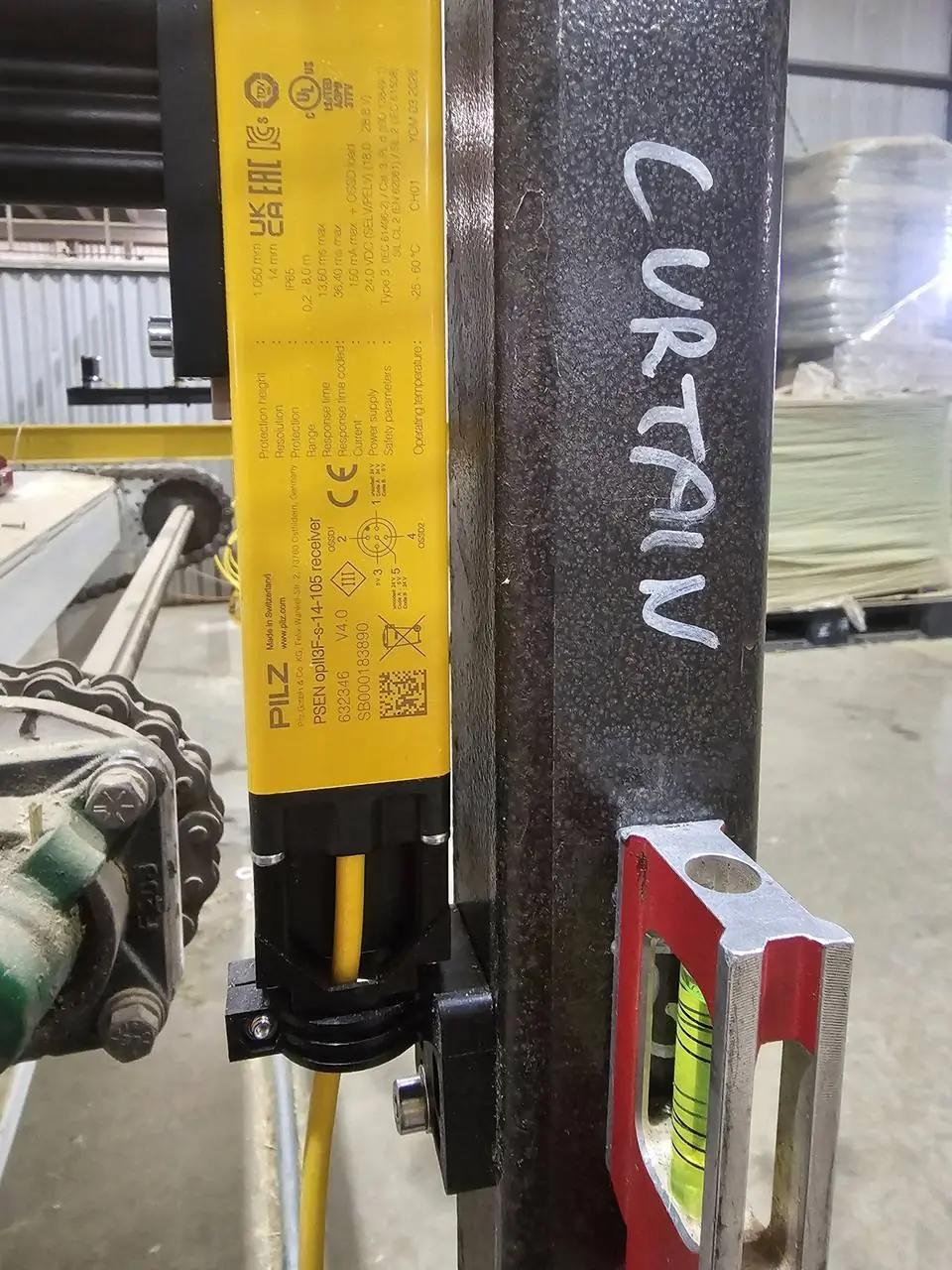
Don't forget reaching over
A vertical curtain that is too short can be reached over. ISO 13855:2010 includes a table of extra distances (CRO) based on the height of the top beam and the height of the hazard. If CRO is larger than C, it must be used instead. The curtain also has to be positioned so nobody can reach under it, go around it, or stand undetected between it and the hazard. If someone can stand inside, a restart interlock or extra presence sensing is needed.
Need light curtains fitted or checked? We measure stopping times, calculate the safety distance and install and validate the system. Send us the scope, drawings or a few photos and an engineer will reply within one business day.
Worked examples
These use example stopping times only. Real values must come from measurement on your machine.
| Example 1: 14 mm finger curtain | Example 2: 30 mm hand curtain | Example 3: 4-beam access guard | |
|---|---|---|---|
| Detection capability (d) | 14 mm | 30 mm | Multi-beam, beams at 300, 600, 900 and 1,200 mm |
| Overall stopping performance (T) | 0.20 s | 0.35 s | 0.50 s |
| First calculation | S = 2000 x 0.20 + 8(14 - 14) = 400 mm | S = 2000 x 0.35 + 8(30 - 14) = 828 mm | S = 1600 x 0.50 + 850 = 1,650 mm |
| Is S over 500 mm? | No, so K = 2000 stands | Yes, so recalculate with K = 1600 | Not applicable, K = 1600 already |
| Recalculation | None | S = 1600 x 0.35 + 128 = 688 mm | None |
| Minimum distance | 400 mm | 688 mm (not less than 500 mm) | 1,650 mm |
Example 2 shows why the 500 mm step matters: the second calculation moves the curtain 140 mm closer to the hazard than the first. Example 3 shows why stopping time drives everything with body detection. Every 100 ms of stopping time adds 160 mm to the distance.
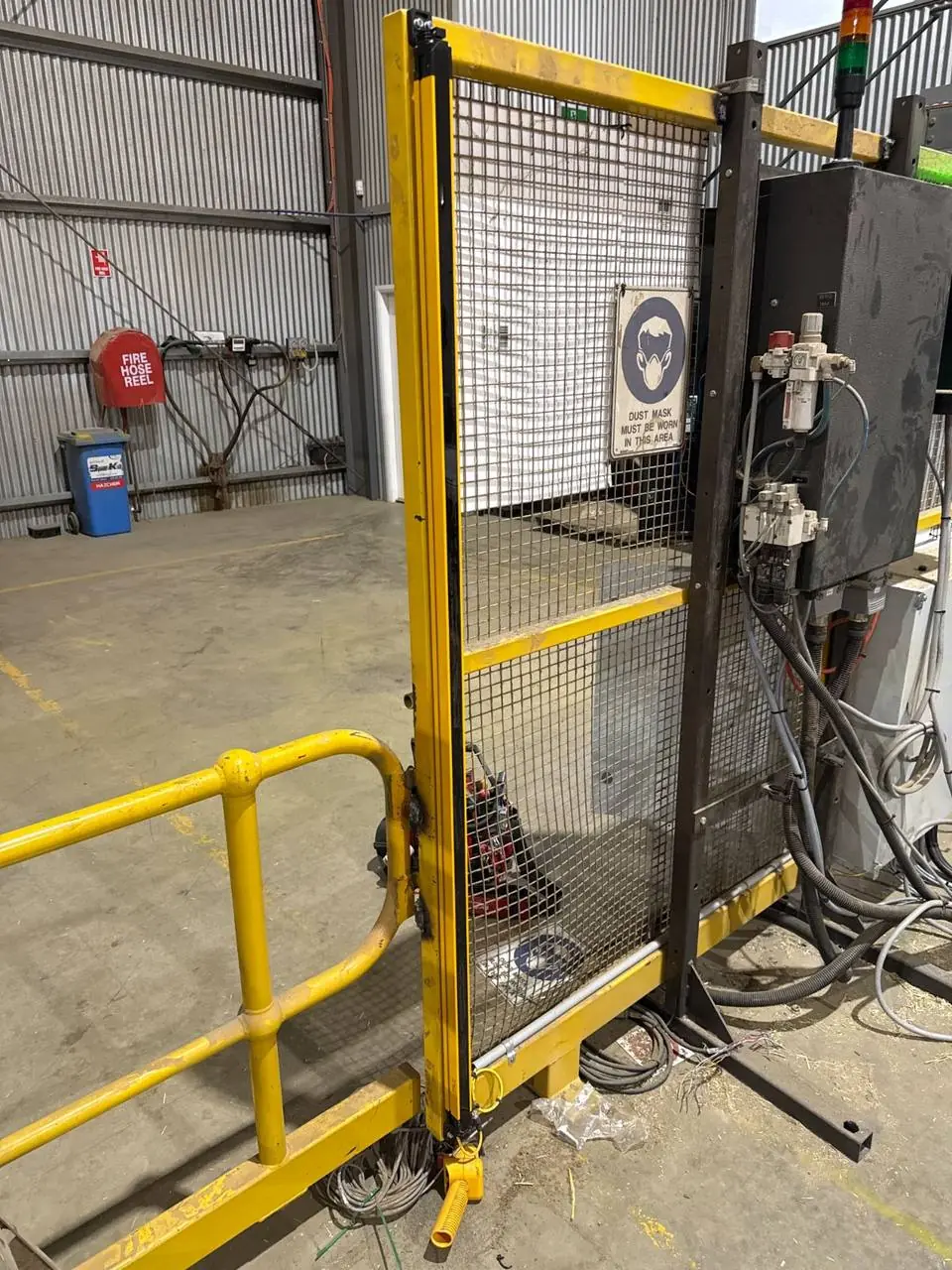
On a real job, our pallet wrapper safety system project measured the wrapper's stopping performance and worked the minimum distance out to 1,278 mm, which set where the muted light curtains were mounted.
Measuring stopping time
T is the sum of every delay between someone breaking the beam and the hazardous motion stopping:
- The light curtain's response time, from its data sheet
- The safety relay or safety PLC response time, including input filtering and any network delays
- Contactor drop-out, or the drive's safe torque off response
- The machine's mechanical stopping time, including brakes, inertia and gravity
The mechanical stopping time should be measured with a stopping-time analyser, not estimated. Test at the worst case (top speed, heaviest load, and both warm and cold where it matters), repeat the test several times and use the longest result. Brakes wear, so allow a margin or monitor stopping performance, and repeat the measurement at regular intervals and after any change to the machine, drive settings or brakes.
Muting: letting product through
On conveyors and pallet wrappers, the curtain has to let pallets through without letting people through. Muting does this by temporarily suspending the curtain while sensors confirm that it is the load, not a person, entering. IEC 62046 gives guidance on muting. Good practice includes:
- Muting sensors arranged so only a pallet, in the right direction and sequence, can trigger muting
- Muting handled by the safety relay or safety controller, never by the standard PLC alone
- A muting time limit and a muting indicator lamp where required
- Muting only for as long as the load blocks the opening
- Guarding around the load so nobody can walk in beside it
The light curtain and its muting must also meet the Performance Level required by the risk assessment. A Type 4 light curtain to IEC 61496 is usually needed for higher PLs. Our guide to safety categories and Performance Levels explains how that level is set.
Common mistakes
- Using the light curtain's response time as T and forgetting the machine's own stopping time
- Using a stopping time from the machine's manual instead of measuring it on the installed machine
- Measuring the distance to the guard frame instead of from the detection zone to the nearest hazard point
- Choosing a 30 mm curtain for a job that needs finger detection, then mounting it at the 14 mm distance
- Leaving gaps beside, under or over the curtain that let someone bypass it
- Changing drive ramp times or speeds later without re-measuring stopping time and rechecking the distance
How AMC helps
AMC carries out machine risk assessments to AS 4024, measures stopping performance, calculates safety distances and designs light curtain, muting and safety controller systems using SICK and Pilz devices and Allen-Bradley GuardLogix. We build the control panels in our Griffith workshop, install and validate on site, and apply the same approach to robot cells and palletisers.
This guide is general information. Safety distances must be calculated for your machine from measured stopping performance and a documented risk assessment, using the current standards and the light curtain maker's instructions. Written by the AMC Electrical & Automation engineering team in Griffith, NSW. Last checked November 2026.
FAQs
Common questions about light curtain safety distance
What is the formula for light curtain safety distance?
ISO 13855, adopted in Australia as AS 4024.2801:2017, uses S = (K x T) + C. K is the approach speed, T the overall stopping time and C an intrusion allowance based on the curtain's resolution.
What is the minimum distance for a light curtain?
For a finger or hand curtain it is never less than 100 mm, and if the calculation with 2,000 mm/s exceeds 500 mm, the recalculated distance using 1,600 mm/s must still be at least 500 mm. The real minimum depends on the stopping time of your machine.
Why is C equal to 850 mm for multi-beam light grids?
Beams that are hundreds of millimetres apart can't detect a hand or arm reaching through, so ISO 13855 adds 850 mm to allow for the reach of an arm before the body is detected.
How do you measure machine stopping time?
With a stopping-time analyser that breaks the beam and records how long the hazardous motion takes to stop. Test at worst-case speed and load, repeat it several times and use the longest result.
Can I mount a light curtain closer if I use a faster one?
A faster curtain response reduces T slightly, but the machine's stopping time is usually the biggest part. Faster braking, a quicker safe torque off or reduced speed usually make a bigger difference.
Has ISO 13855 changed?
ISO 13855:2024 was published as a third edition with a restructured formula and more detailed supplements. Australia's AS 4024.2801:2017 still adopts the 2010 edition, so check which one your project specifies.
Does muting make a light curtain less safe?
Not if it is designed properly. Muting must be controlled by the safety system, triggered only by the load in the right sequence and limited in time, with guarding so nobody can enter alongside the load.
Next step
Got a plant, machine or board that needs sorting?
Send us the scope, drawings or a few photos. An engineer reads every request and comes back within one business day with next steps and a clear, upfront price.
Project engineer or OEM? Send a P&ID, equipment list or scope for a budget price.