Home / Machine safety / Categories & Performance Levels
Guide · Machine safety
Safety categories and Performance Levels: a plain guide for Australian machinery
What Category 3, PLd and PLr actually mean, how the required Performance Level is chosen, and which standards apply in Australia.
Safety categories and Performance Levels describe how reliable a machine's safety circuits need to be. If a risk assessment, a supplier quote or a WorkSafe inspector has mentioned "Category 3", "PLd" or "PLr", this guide explains what those terms mean, how the required level is worked out, and how the Australian AS 4024 standards line up with ISO 13849-1.
The short answer
- Category (B, 1, 2, 3, 4): describes the structure of a safety circuit, mainly whether one fault can stop it working and whether faults are detected
- Performance Level (PLa to PLe): describes how likely the safety function is to fail dangerously. PLa is the lowest, PLe the highest
- PLr: the required Performance Level for one safety function, worked out from the risk assessment
- The rule: the PL the design actually achieves must be equal to or higher than the PLr
A category on its own is no longer the whole answer. Under ISO 13849-1 the category is one input into the Performance Level, along with component reliability, diagnostics and protection against common cause failures.
Which standards apply in Australia
Australia's machinery safety standards sit in the AS 4024 series, and several parts deal with safety-related control systems:
- AS/NZS 4024.1503:2026 adopts ISO 13849-1:2023, with some modifications. It is the Performance Level standard and replaced AS/NZS 4024.1503:2014, which adopted the 2006 edition of ISO 13849-1
- AS 4024.1501-2006 and AS 4024.1502-2006 cover the older categories-only method for design and validation. They are still listed as current, so you will still see designs and specifications written to them
- AS/NZS 62061:2025 adopts IEC 62061, the alternative functional safety standard for machinery, which uses Safety Integrity Levels (SIL) instead of PLs
Australian Standards are not law in themselves. Under the WHS laws, designers, manufacturers, suppliers and the business running the machine must manage risks so far as is reasonably practicable, and the AS 4024 series is widely used as evidence of what that looks like. Our guide to AS 4024 machine safety covers the wider series.
Safety categories B, 1, 2, 3 and 4
Categories describe how a safety circuit behaves when something fails. They came from the older EN 954-1 approach and were carried into ISO 13849-1, where they became one of the building blocks of a Performance Level.
| Structure | What a single fault does | Diagnostics (DCavg) | Highest PL it can reach | |
|---|---|---|---|---|
| Category B | Single channel, basic safety principles | Can cause loss of the safety function | None | PLb |
| Category 1 | Single channel, well-tried components and principles | Can cause loss of the safety function, but is less likely | None | PLc |
| Category 2 | Single channel plus a periodic test | Can cause loss of the function between tests; the test detects it | Low to medium | PLd |
| Category 3 | Two channels | Does not cause loss of the function; most faults are detected | Low to medium | PLe (with high MTTFd) |
| Category 4 | Two channels with high diagnostics | Does not cause loss of the function; faults are detected in time | High (99% or more) | PLe |
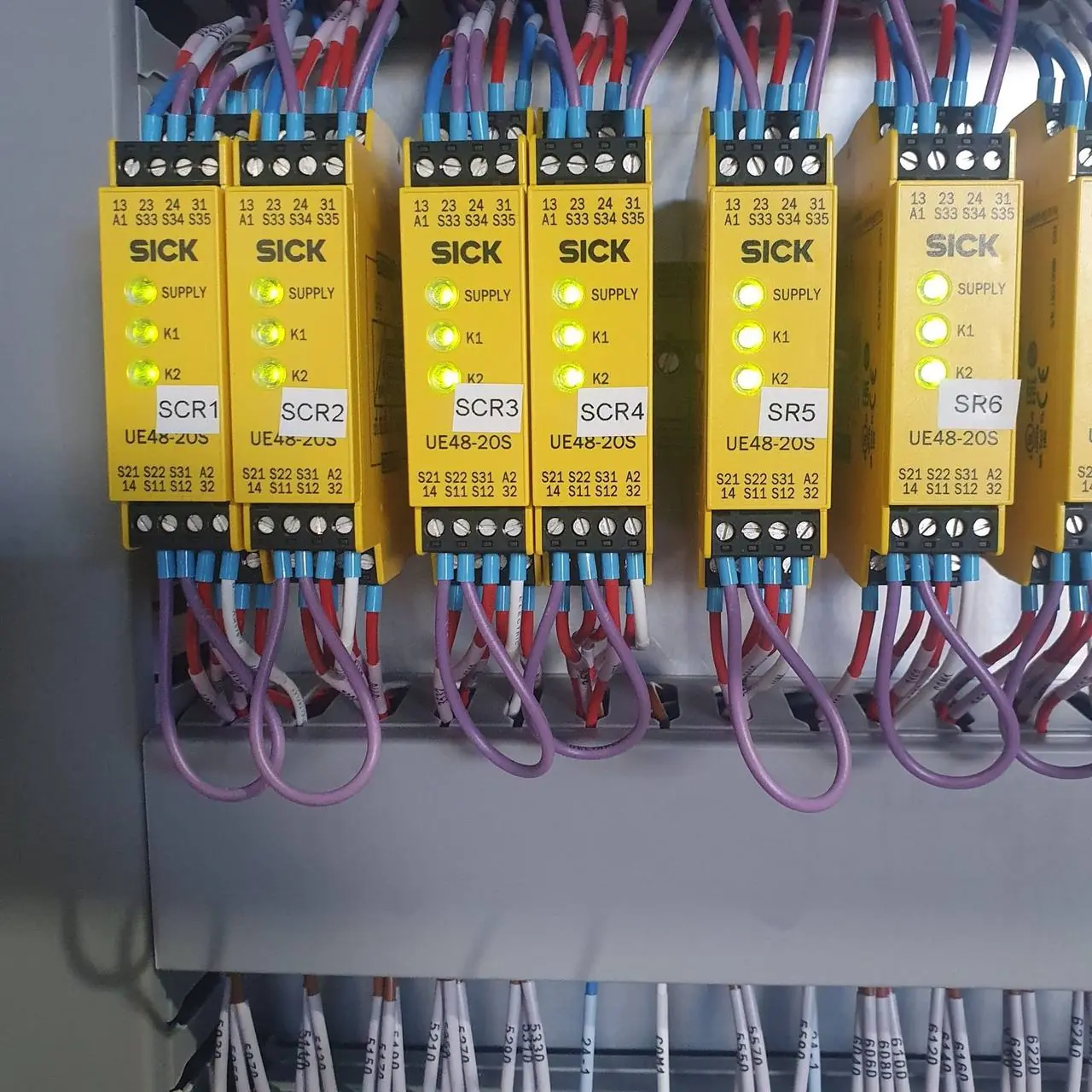
When people ask for a "Category 3 safety circuit", they usually mean a dual-channel circuit: two contacts on the e-stop or gate switch, two contactors or a safe torque off input on the drive, and a safety relay or safety controller that checks both channels and the contactor feedback. A single welded contact or a shorted wire will not stop the machine stopping, and the monitoring will refuse a restart until the fault is fixed.
Category 3 is not automatically PLd, and Category 4 is not automatically PLe. The components used and the quality of the diagnostics decide where the circuit lands.
Performance Levels PLa to PLe
Each Performance Level matches a band of average probability of dangerous failure per hour (PFHd):
- PLa: 10-5 up to 10-4 per hour
- PLb: 3 x 10⁻⁶ up to 10-5 per hour
- PLc: 10-6 up to 3 x 10⁻⁶ per hour
- PLd: 10-7 up to 10-6 per hour
- PLe: 10-8 up to 10-7 per hour
Those numbers are not something you measure on site. They come from the architecture of the circuit and the reliability data for each part, usually calculated with a tool such as the free SISTEMA software or the safety device maker's own calculator.
Need a safety circuit designed or checked? We work out the required Performance Level, design the safety function and validate it. Send us the scope, drawings or a few photos and an engineer will reply within one business day.
Finding the PLr with the risk graph
ISO 13849-1 gives a risk graph in its Annex A for choosing the required Performance Level for each safety function. It asks three questions about the hazard the function protects against:
- Severity (S): S1 for slight, normally reversible injury. S2 for serious, irreversible injury or death.
- Frequency and duration of exposure (F): F1 for seldom or short exposure. F2 for frequent to continuous or long exposure.
- Possibility of avoiding the hazard (P): P1 where the person can see it coming and get out of the way. P2 where that is scarcely possible, for example fast or unexpected motion.
| Severity | Frequency / exposure | Possibility of avoiding | PLr |
|---|---|---|---|
| S1 (slight, reversible) | F1 (seldom, short) | P1 (possible) | a |
| S1 (slight, reversible) | F1 (seldom, short) | P2 (scarcely possible) | b |
| S1 (slight, reversible) | F2 (frequent, long) | P1 (possible) | b |
| S1 (slight, reversible) | F2 (frequent, long) | P2 (scarcely possible) | c |
| S2 (serious, irreversible) | F1 (seldom, short) | P1 (possible) | c |
| S2 (serious, irreversible) | F1 (seldom, short) | P2 (scarcely possible) | d |
| S2 (serious, irreversible) | F2 (frequent, long) | P1 (possible) | d |
| S2 (serious, irreversible) | F2 (frequent, long) | P2 (scarcely possible) | e |
The 2023 edition refines how the P parameter is judged, so it also accounts for how likely the hazardous event is to occur. The risk graph is a starting point, not a replacement for judgement: the reasons for each choice should be written into the risk assessment. Our machine risk assessment checklist shows where this fits.
Each safety function gets its own PLr. On one machine, the guard door interlock, the e-stop, a light curtain and a two-hand control can all have different required levels.
MTTFd, DC and CCF: what decides the PL achieved
Once the architecture (category) is known, three more factors decide the Performance Level the design achieves.
MTTFd: how reliable the parts are
Mean time to dangerous failure, in years, for each channel. ISO 13849-1 groups it as low (3 to under 10 years), medium (10 to under 30 years) and high (30 to 100 years). Electronic safety devices come with PFHd or MTTFd data from the maker. Electromechanical parts such as contactors and interlock switches are rated by B10D, the number of operations before 10% fail dangerously, so their MTTFd depends on how often they operate. A contactor on a machine that cycles every few seconds wears through its life far faster than one on an e-stop circuit.
DC: how well faults are detected
Diagnostic coverage is the share of dangerous failures that the system detects. The bands are none (under 60%), low (60% to under 90%), medium (90% to under 99%) and high (99% or more). Monitoring contactor feedback, cross-checking two input channels and comparing valve position sensors are typical ways of earning diagnostic coverage.
CCF: protection against common cause failures
Two channels are only useful if one event cannot knock out both. Annex F of ISO 13849-1 scores measures such as separation of wiring, diversity of components, protection against overvoltage and the environment, and competence of the designers. Categories 2, 3 and 4 need at least 65 points out of 100.
Validation: proving it does what it should
A calculation alone does not make a machine safe. ISO 13849 requires the safety functions to be validated, which means checking that the specification is right and that the built system meets it. The 2023 edition of ISO 13849-1 brought much of the validation material from ISO 13849-2 into the main standard. In practice, validation covers:
- A written safety requirements specification for each function: what it does, its PLr, response time and reset behaviour
- Analysis of the design: the circuit drawings, the PL calculation and the fault list (what was considered and what was excluded, and why)
- Review of the safety PLC program, if there is one, against the specification
- Testing on the machine, including fault injection: pulling one channel, bridging a contact, dropping a feedback signal and confirming the system reacts as designed
- Records that are kept, signed and repeated after any change
Common mistakes
- Buying a "PLe safety relay" and assuming the whole function is PLe. The weakest part of the chain (sensor, logic or output) limits the result
- Wiring dual-channel inputs through one shared cable where a crush or cut can short both channels
- Forgetting the output side: a single contactor with no feedback limits the function no matter how good the relay is
- Choosing the PLr without writing down why, so nobody can check it later
- Changing the machine, speed or guarding and never revisiting the calculation
How AMC helps
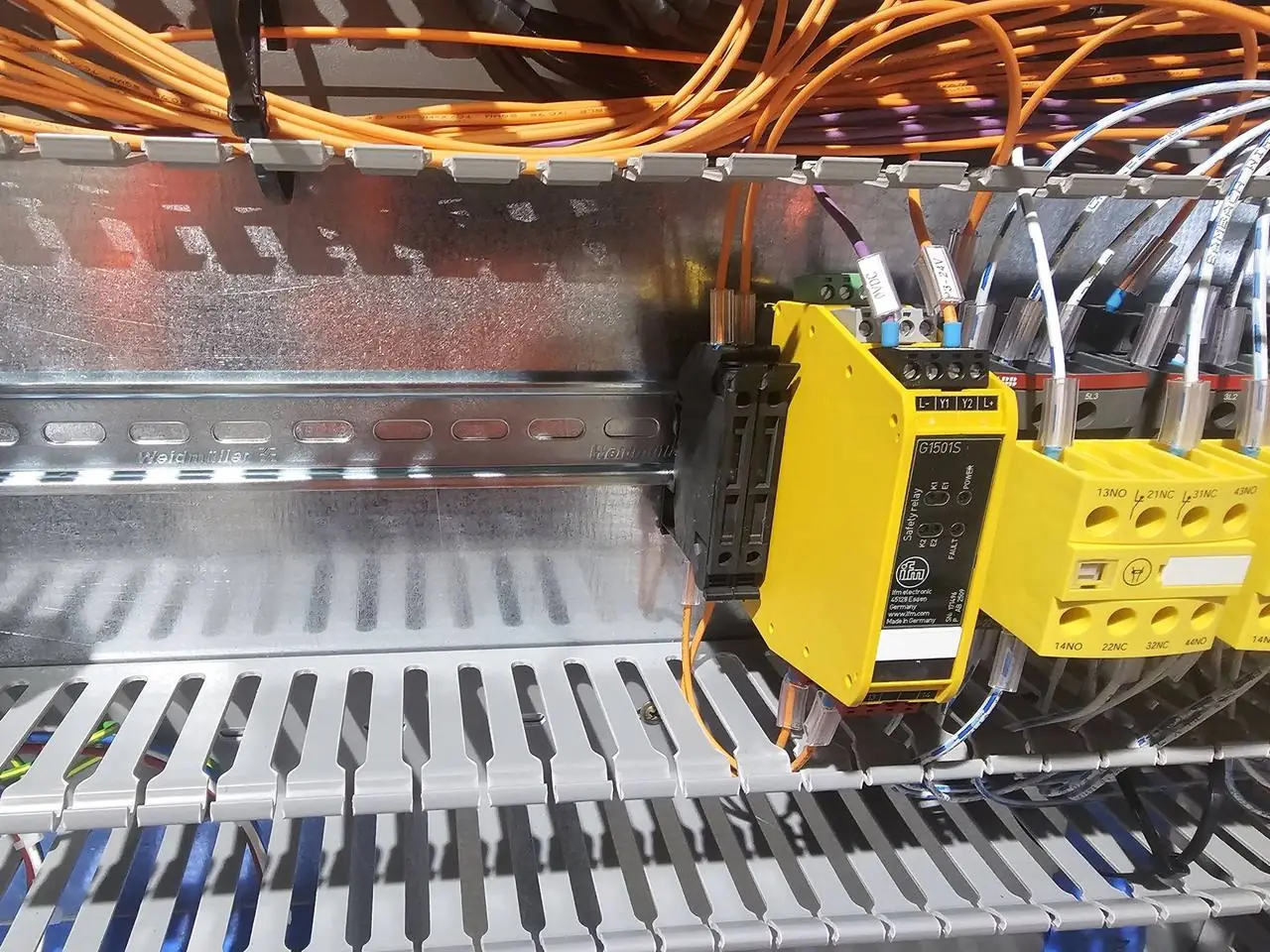
AMC carries out machine safety risk assessments to AS 4024, sets the PLr for each safety function, and designs, builds and validates the control system to meet it. We work with Pilz and SICK safety relays and controllers and Allen-Bradley GuardLogix safety PLCs, build the panels in our Griffith workshop, and test every function on site before handover. On a recent pallet wrapper safety upgrade we took the job from risk assessment through to a safety controller and muted light curtains.
This guide is general information. Safety functions must be specified from a documented risk assessment for your machine, and designed and validated by competent people against the current edition of the standards. Written by the AMC Electrical & Automation engineering team in Griffith, NSW. Last checked November 2026.
FAQs
Common questions about safety categories and PLs
What is the difference between a safety category and a Performance Level?
A category describes the structure of the safety circuit, such as single or dual channel and whether faults are detected. A Performance Level adds component reliability, diagnostic coverage and common cause failure protection to give an overall measure, from PLa to PLe, of how likely the function is to fail dangerously.
What is PLr?
PLr is the required Performance Level for a safety function. It comes from the risk assessment, usually using the risk graph in ISO 13849-1, and the design must achieve a PL equal to or higher than it.
Does Category 3 mean PLd?
Not automatically. Category 3 can reach anywhere from PLb to PLe depending on the reliability of the parts and the diagnostic coverage. Many dual-channel circuits with monitored contactors land at PLd, but it has to be shown by calculation.
Is AS 4024.1501 still used?
AS 4024.1501-2006, the older categories-only method, is still listed as current, so older designs and some specifications refer to it. New designs normally follow the Performance Level method in AS/NZS 4024.1503, which now adopts ISO 13849-1:2023.
Should I use ISO 13849-1 or IEC 62061?
Both are accepted for machinery. ISO 13849-1 suits most machines built from safety relays, interlocks and contactors. IEC 62061, adopted as AS/NZS 62061, uses SIL ratings and is often used for complex electronic or programmable safety systems.
Do I have to redo the calculation if I change the machine?
Yes, if the change affects a hazard or a safety function. A faster cycle, a new guard, a different drive or a software change can all alter the PLr or the PL achieved, so the risk assessment and validation should be reviewed. See our machine safety service for help.
What software is used to calculate a Performance Level?
SISTEMA, a free tool from the German institute IFA, is widely used, along with calculators from safety device makers. Whatever tool is used, the inputs and assumptions need to be documented so the result can be checked.
Next step
Got a plant, machine or board that needs sorting?
Send us the scope, drawings or a few photos. An engineer reads every request and comes back within one business day with next steps and a clear, upfront price.
Project engineer or OEM? Send a P&ID, equipment list or scope for a budget price.