Home / Switchboards & MCCs / VSD vs DOL guide
Guide · Motor starting
VSD vs DOL vs soft starter: choosing a motor starter for industrial and process plant
How direct-on-line, star-delta, soft starters and variable speed drives compare on conveyors, fans, process pumps, mixers and compressors, and a simple checklist for picking one.
VSD vs DOL is one of the most common questions on any new MCC or plant upgrade. Most industrial motors are started one of four ways: direct-on-line (DOL), star-delta, a soft starter or a variable speed drive (VSD). Each choice affects the supply, the mechanical drive train, the energy bill, the size and heat load of the MCC, and how the motor fits into the control and safety system. This guide covers when to use a VSD, when a soft starter is enough, and when plain DOL is still the right answer.
It is written for process and production plant: conveyors, fans, process pumps, mixers, agitators and compressors. If you are choosing a starter for an irrigation or bore pump, our irrigation pump starter guide covers the issues specific to those sites.
The short answer
- DOL: small motors on a strong supply, running at one speed, where a hard start does no harm to the load
- Star-delta: mostly found on older boards. It cuts starting current but also starting torque, and has largely been replaced by soft starters
- Soft starter: larger fixed-speed motors where you need a gentler start and stop, less voltage dip and less mechanical shock
- VSD: where the process needs a variable speed, where fans and pumps run at part load, where you need full torque at low speed, or where speed must be coordinated with other machines
The options compared
| DOL | Star-delta | Soft starter | VSD | |
|---|---|---|---|---|
| Starting current (typical) | 6 to 8 times full load | About a third of DOL | About 2.5 to 4 times full load, adjustable | At or below full load |
| Starting torque | Full locked-rotor torque | About a third of DOL | Reduced, falls with the square of voltage | Up to full torque from low speed |
| Controlled stop | No | No | Yes, soft stop | Yes, ramp or braking |
| Speed control while running | No | No | No | Yes |
| Energy saving on fans and pumps | No | No | No | Yes, where demand varies |
| Harmonics and EMC | None | None | Only while ramping | Needs design: chokes, filters, screened cable |
| Heat in the MCC | Very low | Very low | Low once bypassed | A few per cent of motor power |
| Up-front cost | Lowest | Low | Medium | Highest |
Starting current and starting torque
A standard induction motor switched straight onto the supply draws about six to eight times its full-load current until it reaches speed. On a site with a large transformer and short cable runs that is often fine. On a weaker supply, or with a large motor, the voltage dip can upset other equipment, trip contactors and breach the distributor's limits. In NSW the Service and Installation Rules limit motor starting current and the voltage dip it causes at the connection point, so larger motors need a reduced-current method or the distributor's agreement.
Torque matters as much as current. Star-delta and soft starters both reduce the voltage at the motor, and motor torque falls with the square of the voltage. That is fine for a centrifugal pump or fan, which needs little torque at low speed. It can be a problem for a loaded conveyor, a positive displacement pump, a mixer full of product or a compressor that starts against pressure. These loads need breakaway torque from standstill. A soft starter set too gently on a loaded conveyor will simply sit and heat the motor. A VSD can deliver full rated torque from low speed while still keeping current near full load, which is why drives are common on heavy conveyors and mixers.
Energy: where a VSD pays for itself
For centrifugal fans and pumps, the affinity laws do the work. Flow follows speed, pressure follows the square of speed, and power follows the cube of speed. A fan slowed to 80% speed needs roughly half the power. If the plant currently controls flow with a damper, a throttling valve or a recirculation line, a VSD can save a lot of energy.
The saving shrinks when the load must run at full speed most of the time, or where much of a pump's head is static lift. Conveyors, mixers and positive displacement pumps are constant-torque loads, so power falls roughly in line with speed, not with the cube. On those machines a VSD is usually chosen for process control and gentle handling, not energy. A drive also loses a few per cent of the motor power as heat, so a motor that really does run flat out all day can use slightly more energy on a VSD than on a bypassed soft starter. Energy monitoring on the existing motor before and after is the honest way to prove the case.
Harmonics and the supply
A standard six-pulse VSD draws current in pulses, which puts harmonic currents back into the supply. They heat transformers and cables, can upset other equipment and add to neutral current. The NSW Service and Installation Rules list frequency converters as equipment that can distort the supply wave shape, and require such equipment to comply with AS/NZS 61000.3.2, AS/NZS 61000.3.4 and AS/NZS 61000.3.12. A site with many drives, or one large drive on a small transformer, may also be assessed by the distributor.
The usual tools are drives with built-in DC chokes, AC line reactors, passive harmonic filters, active front end drives or an active filter on the main switchboard. The right answer depends on how much of the site load is drives. A harmonic study at design stage is cheaper than fixing nuisance trips and hot transformers later.
EMC, cables and motor insulation
A VSD switches the motor voltage thousands of times a second. Without care it can interfere with instruments, encoders, PLC analog signals and radio links. Good practice is screened, symmetrical VSD cable with the screen terminated 360 degrees at both ends, separation from signal cables, a proper earthing and bonding plan in the MCC, and a drive with the right EMC filter for the environment. The drive product standard, IEC 61800-3, sets EMC categories for this.
Long motor cables add another issue: voltage reflections can push peak voltage at the motor terminals well above the supply voltage and stress the winding insulation. Older motors not designed for inverter duty are most at risk, along with large motors where shaft voltages can damage bearings. IEC/TS 60034-17 and IEC/TS 60034-25 give guidance on motors fed from converters. The fix is a motor rated for inverter duty, an output reactor, dV/dt filter or sine filter, and insulated bearings or shaft earthing on larger machines. Check the drive manufacturer's maximum cable length before the cable schedule is fixed.
Need starters or drives for an MCC? We size, build and program MCCs with DOL, soft starters or VSDs to suit each motor. Send us the scope, drawings or a few photos and an engineer will reply within one business day.
Safety: STO and stopping
Most modern VSDs, including Allen-Bradley PowerFlex drives, offer Safe Torque Off (STO). STO is defined in IEC 61800-5-2. It removes the power that produces torque in the motor without opening the main contactor, giving an uncontrolled stop, stop category 0 in IEC 60204-1 terms. Wired to a safety relay or a safety controller such as GuardLogix, it can form part of a safety function for guard doors, light curtains and emergency stops on conveyors and machines, at the performance level the risk assessment calls for. Many drives can also do a controlled ramp to stop before STO (stop category 1).
Two points are often missed. STO is not isolation: the drive and motor terminals are still live, so maintenance still needs proper isolation and lock-out. And the safety function as a whole still has to be designed and validated to AS 4024, not just ticked because the drive has an STO input. Our machine safety team does this work alongside the MCC design.
Heat and space in the MCC
DOL and star-delta starters produce little heat. A soft starter only gets warm during the ramp if it has an internal or external bypass contactor, which closes at full speed and takes the thyristors out of circuit. A VSD loses a few per cent of its rated power continuously. Eight 22 kW drives running hard can put well over a kilowatt of heat into a cabinet. That heat must be included in the switchboard's temperature-rise verification and designed out with filtered fans, heat exchangers, air conditioning or through-panel heatsink mounting. In a Riverina summer this is often the deciding factor in MCC size.
Bypass, redundancy and control
For critical fans and pumps, a VSD with a bypass DOL or soft starter lets the plant keep running at fixed speed if a drive fails. It needs careful interlocking so the drive output can never be connected to the supply. Spare drives on the shelf are a simpler option for plants with many identical drives.
VSDs also bring control benefits. Over EtherNet/IP a PowerFlex drive reports current, speed, torque, faults and run hours straight to the PLC and SCADA, and speed references and ramp settings can be managed from the control system. That makes diagnostics faster and supports condition monitoring. See PLC and SCADA programming for how we integrate drives.
Cost over the life of the motor
DOL is the cheapest to buy. A VSD costs more up front, needs more panel space and cooling, and has electronics that will eventually need replacing. Against that, it can save energy on variable fans and pumps, cut mechanical wear on belts, couplings and gearboxes, reduce product damage on conveyors and give useful data. Compare the options over ten years, counting energy, maintenance, downtime and replacement, not just the price on the quote.
A simple selection checklist
- Does the process need variable speed? If yes, it is a VSD.
- Is it a fan or centrifugal pump at part load? A VSD will usually save energy. Check run hours and duty first.
- Does the load need high starting torque? Loaded conveyors, mixers and compressors may not start on a soft starter. Consider a VSD.
- Is the supply weak, or the motor large? Check starting current against the distributor's limit. DOL may not be allowed.
- Is mechanical shock a problem? Belts slipping, product spilling or couplings failing point to a soft starter or VSD.
- Is the motor part of a safety function? A drive with STO wired to a safety controller is often the cleanest answer.
- Can the MCC take the heat and harmonics? Many drives in one board need a cooling and harmonic plan.
- What does it cost over ten years? Include energy, wear, downtime and replacement.
How AMC helps
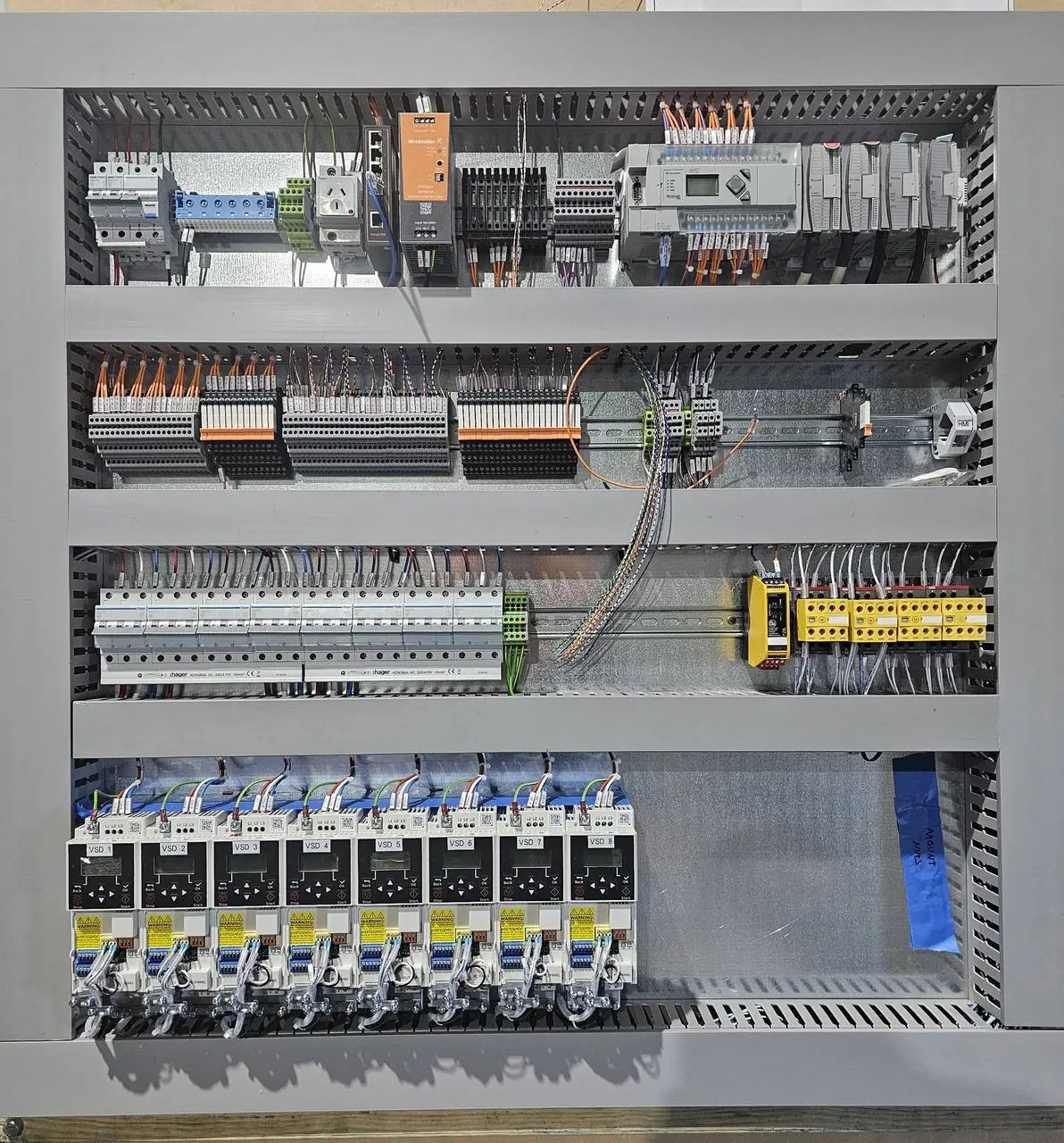
AMC designs and builds MCCs and control panels in our Griffith workshop, with DOL starters, soft starters and Allen-Bradley PowerFlex drives selected for each load. We size the cooling, plan the harmonics and EMC, wire STO into the safety system and program the drives into the PLC and SCADA, so the board arrives tested and ready to commission. On one citrus packing line we built a conveyor control panel with eight VSDs that gives the operators speed control across the whole line.
This guide is general information. Starter and drive selection depends on the load, the motor, the supply and the switchboard at your site, and installations must comply with AS/NZS 3000 and your electricity distributor's rules. Written by the AMC Electrical & Automation engineering team in Griffith, NSW. Last checked November 2026.
FAQs
Common questions about VSDs, soft starters and DOL starters
When should I use a VSD instead of a DOL starter?
Use a VSD when the process needs variable speed, when a fan or centrifugal pump runs at part load for long periods, or when the load needs high torque from standstill without a big current surge. For a small motor that runs at one speed on a strong supply, DOL is simpler and cheaper.
Soft starter vs VSD: what is the difference?
A soft starter only controls the start and stop by ramping the voltage, then runs the motor at full speed, usually through a bypass contactor. A VSD controls the speed all the time by changing the frequency, gives full torque at low speed and can save energy, but costs more and adds heat and harmonics.
Does a VSD save energy on a conveyor?
Not much. Conveyors are constant-torque loads, so power falls roughly in line with speed rather than with its cube. VSDs on conveyors are usually chosen for speed control, gentle starts and product handling.
Is Safe Torque Off the same as isolation?
No. STO stops the drive producing torque and can be part of a safety function, but the drive and motor terminals stay live. Maintenance work still needs proper electrical isolation and lock-out.
Do I need a special motor for a VSD?
Many modern motors are suitable for drive duty, but check with the motor maker, especially for older motors, long cable runs and large machines. An output filter, insulated bearings or shaft earthing may be needed.
Can a soft starter start a loaded conveyor or mixer?
Sometimes, but torque falls with the square of the voltage, so a heavily loaded conveyor, mixer or compressor may not break away on a soft start. A VSD gives full torque from low speed and is the safer choice for these loads.
Do VSDs cause problems with the electricity supply?
They can, through harmonic currents. In NSW, frequency converters must meet the harmonic limits in the AS/NZS 61000.3 series, and sites with many drives may need chokes, filters or active front end drives.
Next step
Got a plant, machine or board that needs sorting?
Send us the scope, drawings or a few photos. An engineer reads every request and comes back within one business day with next steps and a clear, upfront price.
Project engineer or OEM? Send a P&ID, equipment list or scope for a budget price.